Bangalore can feel very different financially depending on whether you are a bachelor sharing accommodation, a couple renting a home, or a family managing education and household expenses. The cost of living in Bangalore in 2026 varies significantly by locality, housing choice and lifestyle. Since available figures are based on different averages and self-reported data, the following ranges should be treated as practical estimates rather than fixed costs.
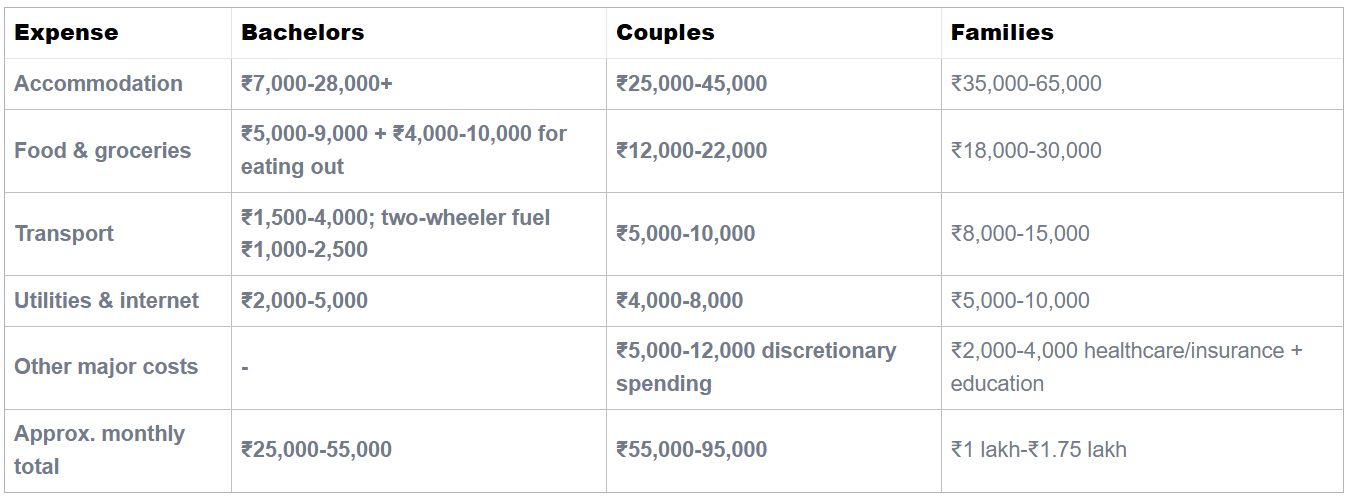
Housing is usually the biggest variable for single professionals. Shared PGs or co-living options in Electronic City, Kengeri and BTM Layout generally fall around ₹7,000-15,000, while 1BHK homes in Marathahalli or HSR Layout can reach ₹15,000-28,000. Koramangala and Indiranagar can exceed ₹25,000.
Home cooking and groceries may require ₹5,000-9,000, with dining, delivery and outings adding ₹4,000-10,000. BMTC and Namma Metro commuting can cost ₹1,500-4,000, while two-wheeler fuel may add ₹1,000-2,500. Utilities, internet and mobile services together may be ₹2,000-5,000.
A frugal bachelor may manage within ₹25,000 monthly, while an independent lifestyle can approach ₹55,000. A ₹40,000-60,000 take-home salary is commonly considered workable, depending on lifestyle and location.
Couples generally spend ₹25,000-45,000 on a 1BHK or 2BHK. Whitefield and Sarjapur Road tend towards the higher end, whereas Yelahanka and Banaswadi offer comparatively lower housing costs. Food and groceries, including some dining out, may total ₹12,000-22,000, while transport, utilities and discretionary expenses take the overall budget to around ₹55,000-95,000. A combined take-home income of ₹90,000-1.2 lakh can provide room for savings alongside regular spending.
For families, a 2BHK or 3BHK typically costs ₹35,000-65,000. Food may require ₹18,000-30,000, while transport can reach ₹8,000-15,000 and utilities ₹5,000-10,000. Healthcare, including a family floater insurance premium, may add ₹2,000-4,000 before routine medical expenses.
Education creates the widest variation. Mid-range private CBSE or ICSE schooling may work out to roughly ₹10,000-17,000 per child each month after accounting for annual fees, transport and supplies, based on ₹1.3-2 lakh annually. Two children can take this beyond ₹30,000 monthly. International and IB schools can cost substantially more and need to be assessed individually. Overall family spending can reach ₹1 lakh-₹1.75 lakh, with ₹1.2-1.5 lakh or more in combined household income generally providing greater comfort and savings capacity.
Bangalore's position among India's expensive cities differs by methodology. Some comparisons place it below Mumbai and, in several categories, Delhi NCR, but above Hyderabad, Pune and Chennai; another ranking identifies Bangalore as India's costliest city. These differences reflect variations in how each index measures expenses.
Technology-sector salaries in Bangalore are often cited as being 10-25% higher than comparable roles in Hyderabad or Pune, helping offset higher living costs. Housing remains particularly volatile, with 2026 tracking reports indicating 8-15% year-on-year rent increases in high-demand locations such as Whitefield and Sarjapur Road.
The cost of living in Bangalore ultimately depends on where you live, how you travel and your household's priorities. Bachelors can reduce expenses substantially through shared housing, while couples benefit from shared household costs but face higher rent. Families need to plan more carefully because education can significantly alter the monthly budget.
These figures are useful for initial planning, but actual spending can differ considerably between neighbourhoods and households. Rent, fees, and utility figures in this article are indicative and change frequently with locality, demand, and policy revisions. Readers should treat these as a planning reference and verify current rates before making housing or budget decisions.
1. What is the average cost of living in Bangalore for a bachelor in 2026?
The estimated monthly cost for a bachelor ranges from about ₹25,000 to ₹55,000, depending mainly on accommodation and lifestyle.
2. How much does a couple need to live comfortably in Bangalore?
A couple may spend around ₹55,000-95,000 per month, with ₹60,000-80,000 representing a commonly cited comfortable range.
3. How much does a family need to live in Bangalore?
A family of three or four may require approximately ₹1 lakh-₹1.75 lakh monthly, with education being a major variable.
4. Which Bangalore areas are comparatively affordable for renters?
Kengeri, BTM Layout, Yelahanka and Banaswadi are among the comparatively lower-cost locations mentioned in the supplied data.
5. Why does the cost of living vary so much across Bangalore?
Locality, rent, accommodation type, commuting method, dining habits and household size can substantially change monthly expenditure.
6. Is Bangalore more expensive than other Indian metros?
Bangalore's ranking varies between cost-of-living comparisons, although it is generally positioned above Hyderabad, Pune and Chennai while technology-sector salaries can be higher than in some competing cities.